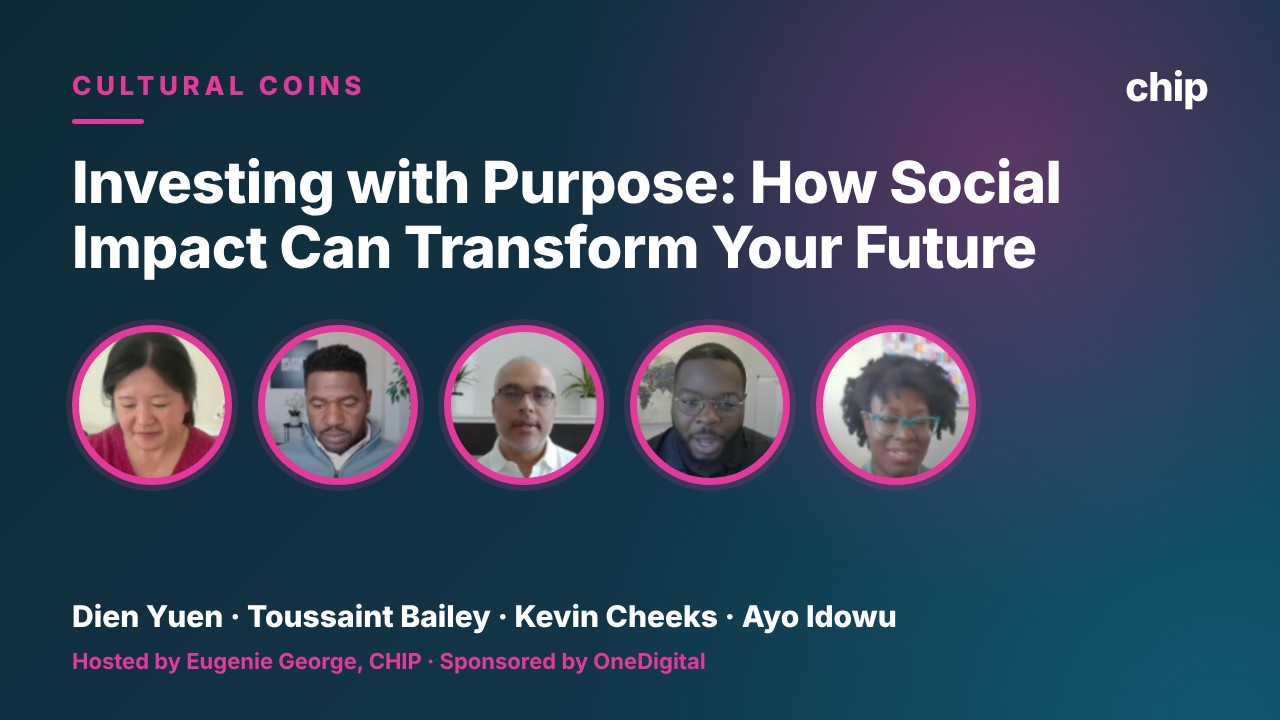
Investing with Purpose: How Social Impact Can Transform Your Future
Can your money grow and do good at the same time? In this Cultural Coins conversation, sponsored by OneDigital, host Eugenie George explores social impact investing with four pros. Dien Yuen, CEO of Daylight, trains advisors on philanthropy and impact. Toussaint Bailey is managing partner of Uplifting Capital. Kevin Cheeks is founder of Impact FI, a Bay Area investment advisory firm. Ayo Idowu, AMPA, is a wealth advisor in the Twin Cities and former pro football player.
Key takeaways
- Social impact investing means aligning your money with your values.
- Impact options sit on a spectrum, from pure philanthropy to market-rate impact investing.
- You don’t need to be wealthy to start. Retail funds, CDFIs and community banks are open to many investors.
- Planned giving and donor-advised funds can turn generosity into a strategy.
- Impact also comes through your time, your network and your story.
Why they got into social impact investing
Ayo grew up in a hardworking family that equated money with hours worked. In college, he noticed a dorm neighbor who earned more from day trading than Ayo did from three jobs. That sparked his mission: teach people who look like him how to make money while they sleep. He defines socially responsible investing simply. If something is close to your heart, you can align your values and still make money.
Toussaint spent more than a decade as a lawyer before moving into wealth management. He saw a gap: private market investments and values-based investing rarely came together. So he built a firm focused on private impact investments in areas like affordable housing, infrastructure, private equity and venture capital. Kevin left big-bank private banking after hearing a manager say the job was to help rich people get richer. Dien came from nonprofit work and became a philanthropy advisor during the dot-com boom, helping entrepreneurs plan how and where to give.
The impact investing spectrum
Social impact investing, ESG and impact investing often get blurred together. Toussaint explains them as points on a spectrum:
- Philanthropy: all impact, no expected financial return.
- Socially responsible investing (SRI): screens out companies or industries that harm the world.
- ESG: considers environmental, social and governance factors partly to reduce long-term risk.
- Impact investing: targets specific, measured outcomes, often while aiming for market-rate returns.
- Traditional investing: focused only on returns.
Ayo adds that values-based investing was once seen as giving up returns. In recent years, he says, that view has shifted.
Ways to invest with impact at any level
Many private impact deals are limited to accredited investors, which puts them out of reach for most people. But the panel points to plenty of options for everyday investors:
- Impact-focused ETFs and mutual funds. Look past the label to see what the fund actually holds.
- Separately managed accounts that let you screen investments by the themes you care about.
- Proxy voting. If you own individual stocks, you can vote on company decisions, and some fund companies are starting to pass votes through to investors.
- CDFIs, community banks and Black-owned banks that reinvest in local businesses and neighborhoods.
Giving with a plan
Dien reminds families that impact doesn’t have to happen today. Planned gifts, bequests and charitable trusts can support the causes you love while you still receive income. Ayo has seen clients who never gave before light up after opening a donor-advised fund. It becomes a giving budget that can grow, with a tax benefit, and they enjoy deciding where it goes. Toussaint adds that giving rarely feels like a loss. It tends to add to your life.
Impact isn’t only about money, either. Dien shares the six Ts: time, talent, treasure, ties, testimony and truth. Your relationships and your story can be worth as much as a check. Ayo puts that into practice with free financial literacy workshops in his community.
Ready to align your investments with your values? Values-based investing works best as part of a complete plan, so consider building a financial team with an advisor, a tax pro and an estate attorney who understand your goals.
Want more conversations like this? Watch more Cultural Coins episodes.
This article is for education only and isn’t investment, tax or legal advice. All investing involves risk. Talk with a qualified professional about your situation before making decisions.
Your next step
- Take the free 3-minute Prosperity Matrix™ quiz to find your money archetype and financial season.
- Get matched now with a Black, Hispanic or multicultural CFP, financial advisor, CPA or estate attorney who understands your culture.