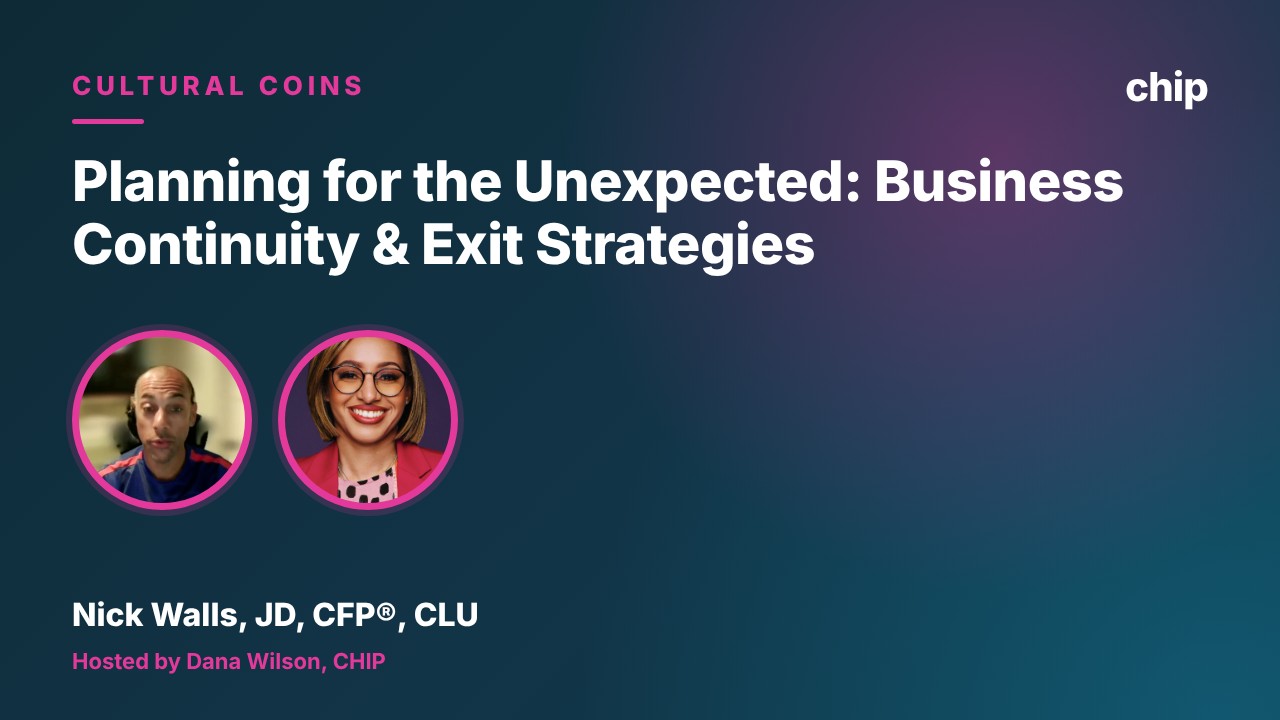
Planning for the Unexpected: Business Continuity & Exit Strategies with Nick Walls
Most business owners put off two big conversations: what happens if something unexpected hits, and their business exit strategy. In this Cultural Coins conversation, Dana Wilson talks with Nick Walls, a Certified Financial Planner, private wealth advisor and “recovering attorney” at BMG, a Milwaukee firm that works almost entirely with owners of privately held businesses.
Key takeaways
- A continuity plan keeps your business running through a disruption, like losing an owner or key person.
- Know who your key people are, what the business is worth and what each person is worth to it.
- Insurance for the death or disability of an owner or key person should come first.
- Start exit planning at least five to seven years before you want out.
- Your operating agreement and buy-sell agreement are the two must-have documents.
Continuity planning and your business exit strategy
Business continuity planning means setting up a system so your business can keep operating through a disruptive event. Without one, Nick says, a single event can undo years of hard work and the plans you had for the business, whether that’s selling it someday or using it to secure your family’s future.
Owners usually remember the obvious protections, like liability insurance. The blind spot is the death or disability of an owner, partner or key person. “Business owners are just humans,” Nick says, and most humans don’t like to plan for the worst.
It takes hours, not months
Setting up a plan isn’t hard, especially with a team that has done it before. Nick’s point: out of thousands of working hours a year, a couple of hours spent on this can protect everything else. He borrows from Stephen Covey’s The 7 Habits of Highly Effective People, urging owners to spend time on work that’s important but not urgent.
Protect your key people
Nick walks owners through three steps:
- Name your key people. Many owners haven’t thought about it until he asks, then quickly realize how much one person holds together.
- Value the business. You can’t measure what a person is worth to the company until you know what the company is worth.
- Insure against the loss. With real numbers, it’s easier to justify the right amount of key person coverage to an insurer.
In a closely held business, losing an owner without a plan can legally shut the business down. Insurance creates the cash to keep it going. Review the plan every year, because people join, leave and take on bigger roles, and the owner should be part of every review.
Family and generational businesses
When family runs or will inherit the business, estate planning becomes essential. Nick describes a common scenario: two children work in the business and two don’t. If a valuable company passes to some siblings without a plan to balance things out, resentment can follow for generations.
Planning your business exit strategy
Ideally, you’d think about your exit when you start the business. At minimum, start five to seven years ahead. “You can’t just wake up on a Tuesday” and decide to sell. Nick outlines three common paths:
- Sell to an outside buyer: usually with help from an investment bank or business broker to create competition and drive the price up.
- Pass it to family: the opposite goal. You lower the price to make it affordable, within IRS limits, after securing your own retirement. Gifts may use part of your estate tax exemption and require a gift tax return.
- Sell to employees through an ESOP: a fit for owners who want to protect the culture they built and reward long-time employees while still getting paid.
Whatever the path, two documents matter most: your operating agreement (or partnership agreement), which governs how these scenarios play out, and a buy-sell agreement, which spells out what happens at death, disability, retirement or an early exit.
Connect your business exit strategy to your personal wealth
Too often, Nick says, the business plan and the owner’s personal financial plan are handled separately. His firm starts by finding the owner’s “wealth gap”: what you need from a sale to live the life you want. If the business isn’t worth that yet, you have time to build value by cleaning up operations, accounting and technology, and moving from founder-led to leader-led. That clarity also helps you walk away from offers that don’t meet your goals.
Whatever business exit strategy you choose, his closing advice is the same: slow down, make time for long-term planning and don’t do it alone.
Want more conversations like this? Watch more Cultural Coins episodes.
This article is for education only and isn’t legal, tax or financial advice. Talk with qualified professionals about your business before making decisions.
Your next step
- Take the free 3-minute Prosperity Matrix™ quiz to find your money archetype and financial season.
- Get matched now with a Black, Hispanic or multicultural CFP, financial advisor, CPA or estate attorney who understands your culture.